Convert a bank statement to QFX for Quicken
To turn a bank statement to QFX, upload the PDF from your online banking and press Convert. Statesift reads each transaction, checks the rows against the opening and closing balance, and writes a .qfx file. Quicken may accept it as Web Connect data, but it does not promise support for converted files, so a CSV comes with every run.
By The Statesift team (Product and testing). Last updated .
PDF up to 15 MB. Read in memory, never stored.
How to convert a bank statement to QFX, step by step
- Download the statement PDF from your online banking. Scans and photos will not work.
- Drop the PDF into the box above and add its password if the bank protected it.
- Optional: type a bank ID for the INTU.BID tag, or leave the default 3000.
- Press Convert, check the balance stamp, then download the .qfx file and import it in Quicken.
Your first statement is free with a free account, up to 5 pages. After that, see the pricing page for prices and plans, or read how we test the tool.
Bank statement to QFX tested with a real statement
We ran one of our own test statements through the same code the tool on this page uses. So the pictures and the numbers below come from that run, not from a mockup.
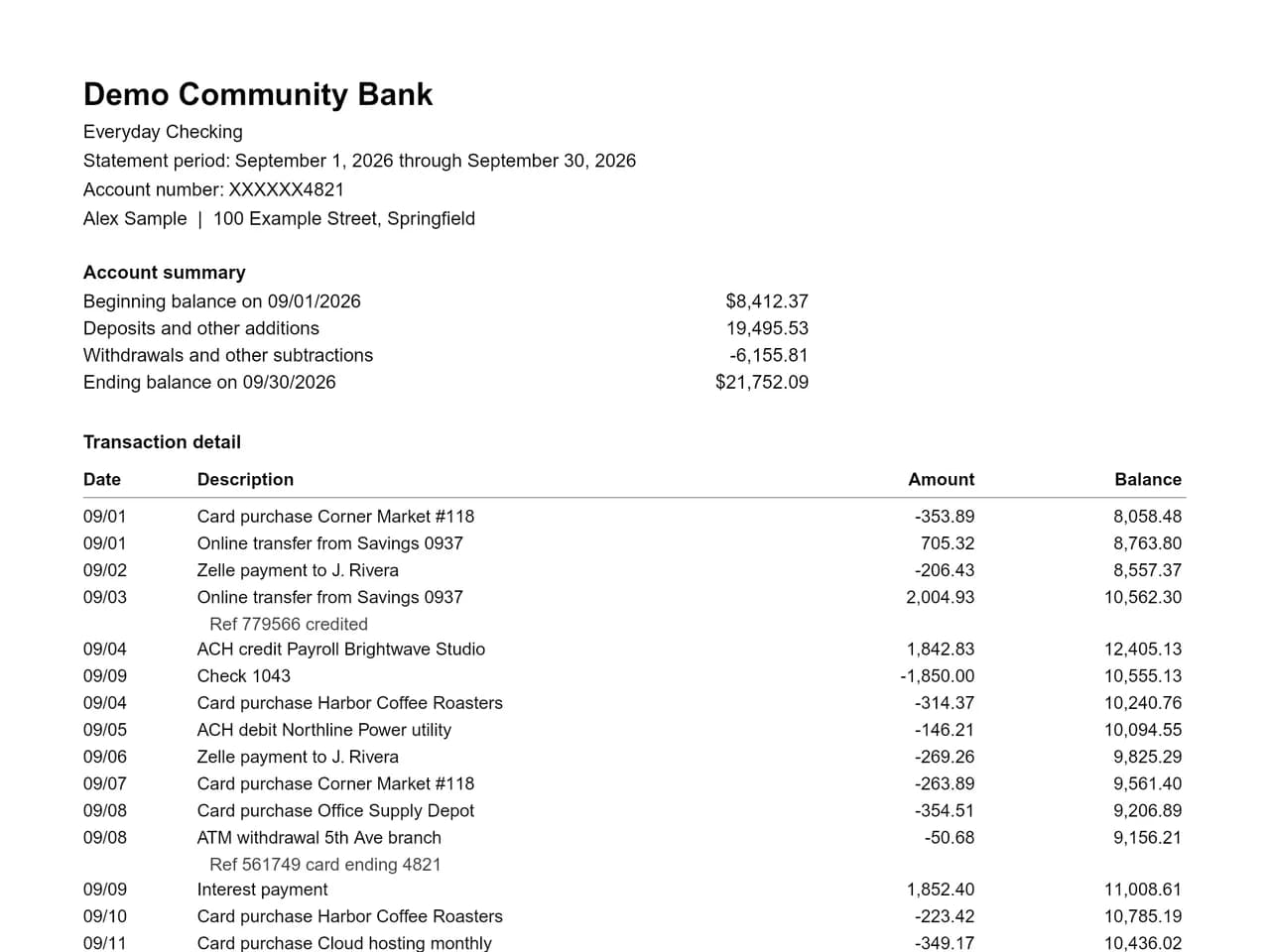
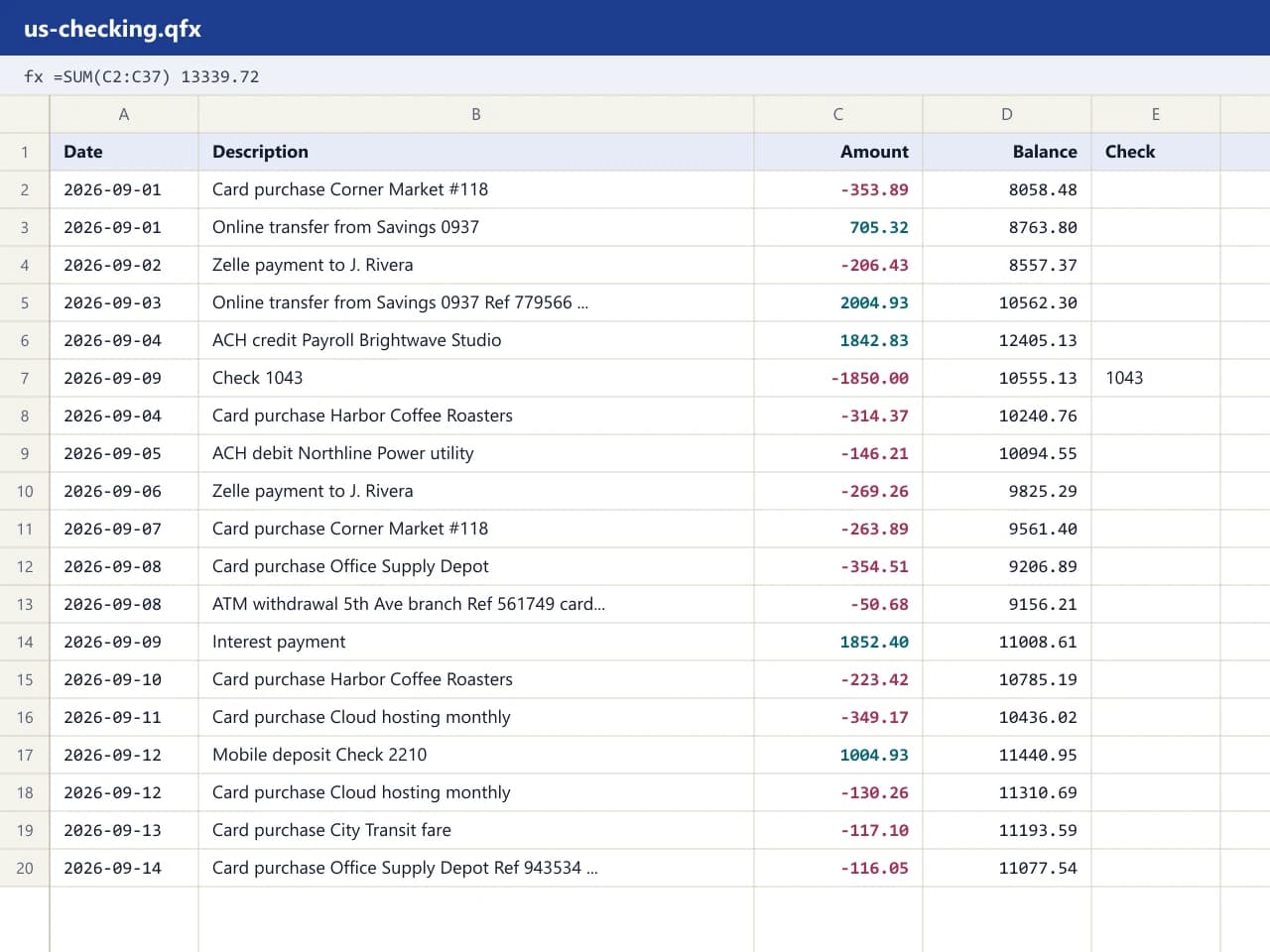 Balanced
- Test input
- us-checking.pdf
- Output
- us-checking.qfx
- Rows
- 36
- Money in
- 19495.53
- Money out
- 6155.81
- Pages
- 2
- Currency
- USD
- Output size
- 7 KB
- Engine time
- 28 ms
How we test: each test statement prints an opening and a closing balance, and the run only counts when the rows add up to both. More on the about page.
Why Quicken wants a QFX file
QFX stands for Quicken File eXchange. It uses the same layout as OFX, but it adds Intuit tags that name the bank, mainly INTU.BID. Quicken calls the import of these files Web Connect. In its own help, Quicken says QFX is mostly for banks that do not offer Direct Connect or Express Web Connect.
Quicken also mentions a second use: loading older transactions that a live connection no longer reaches. That is where a PDF helps. Many banks keep statement PDFs for longer than they offer downloads, so converting a bank statement to QFX is one way to try to fill the missing months in your file.
Import the bank statement to QFX file in Quicken
First, back up your Quicken data file, as Quicken itself suggests. On Windows, Quicken's help points to File, then File Import, then Quicken Transfer Format (.QFX) File. On a Mac, the path is File, then Import, then Bank or Brokerage File (OFX, QFX). After that, link the import to the account the statement belongs to.
If the account already holds some of the same dates, look for doubles after the import. Quicken's Windows help says to delete any duplicate transactions at this step. Our file gives each row its own transaction ID, so a clean import of a new month should not need that cleanup.
What our QFX file carries
Each row has a posted date, a signed amount, a description and a unique ID. Check numbers stay in their own tag, and long descriptions keep their full text in the memo. Checking and savings statements use the bank format, while card statements use the credit card format. As a result, purchases show as charges and payments as credits.
Before you download, the balance check compares the opening balance plus all rows with the closing balance. If the statement prints a running balance, every row is tested against the one above it as well. So you know whether the file is complete before it reaches your Quicken register.
When this is not the right tool
Be clear on one point first. Quicken's Web Connect troubleshooting page says it does not support QFX files made by third party conversion tools, PDF to QFX included. Quicken also validates each Web Connect file online, and it cannot authorize a file for a bank outside Web Connect. So Quicken may reject our QFX file, and its support team will not help with one that fails.
If that happens, use the CSV from the same run. Quicken for Windows imports banking CSV files, but it wants a strict column order, so rearrange our columns to match its list first. Unlike QFX, a CSV import does not match existing rows. Also, a QFX download from your bank or a Direct Connect link always beats a converted file, and we cannot read scanned statements yet.
Bank statement to QFX in short
| Item | Detail |
|---|---|
| Input | PDF checking, savings or credit card statement with a text layer |
| Output | .qfx (OFX 1.0.2 plus INTU.BID), with Excel, CSV, OFX, QBO and JSON in the same run |
| Bank ID | 3000 by default, or the number you type in the form |
| Quicken support | Quicken does not support QFX files from conversion tools, so it may reject them |
| Fallback | CSV from the same run, rearranged to Quicken's CSV column order (Windows) |
| Free use | First statement free, up to 5 pages, with a free account |
| Privacy | The PDF is read in memory and discarded, and we never ask for a bank login |
Bank statement to QFX FAQ
How do I convert a PDF bank statement to QFX?
Upload the PDF on this page and press Convert. The tool writes a .qfx file together with Excel, CSV, OFX, QBO and JSON versions of the same rows, so you can keep a spreadsheet copy as well.
How do I import a QFX file into Quicken?
Back up your data file first. On Windows, choose File, File Import, Quicken Transfer Format (.QFX) File. On a Mac, choose File, Import, Bank or Brokerage File (OFX, QFX). Then pick the matching account.
Will Quicken import a QFX file from a converter?
Sometimes, but Quicken does not promise it. Its help says QFX files from third party conversion software are not supported, so treat the QFX as a first try and the CSV as your backup.
Is QFX the same as OFX?
The layout is the same, but QFX adds Intuit tags such as the bank ID. Quicken expects those tags for Web Connect, which is why a plain OFX file can fail there.
Why does Quicken not accept my QFX file?
Quicken validates Web Connect files online and says it does not support QFX files from conversion tools. Typing your own bank's ID in the Bank ID field may help, but there is no guarantee. Otherwise, import the CSV instead.
Can I convert a credit card statement to QFX?
Yes. Card statements become credit card files, so Quicken shows purchases as charges and payments or refunds as credits.